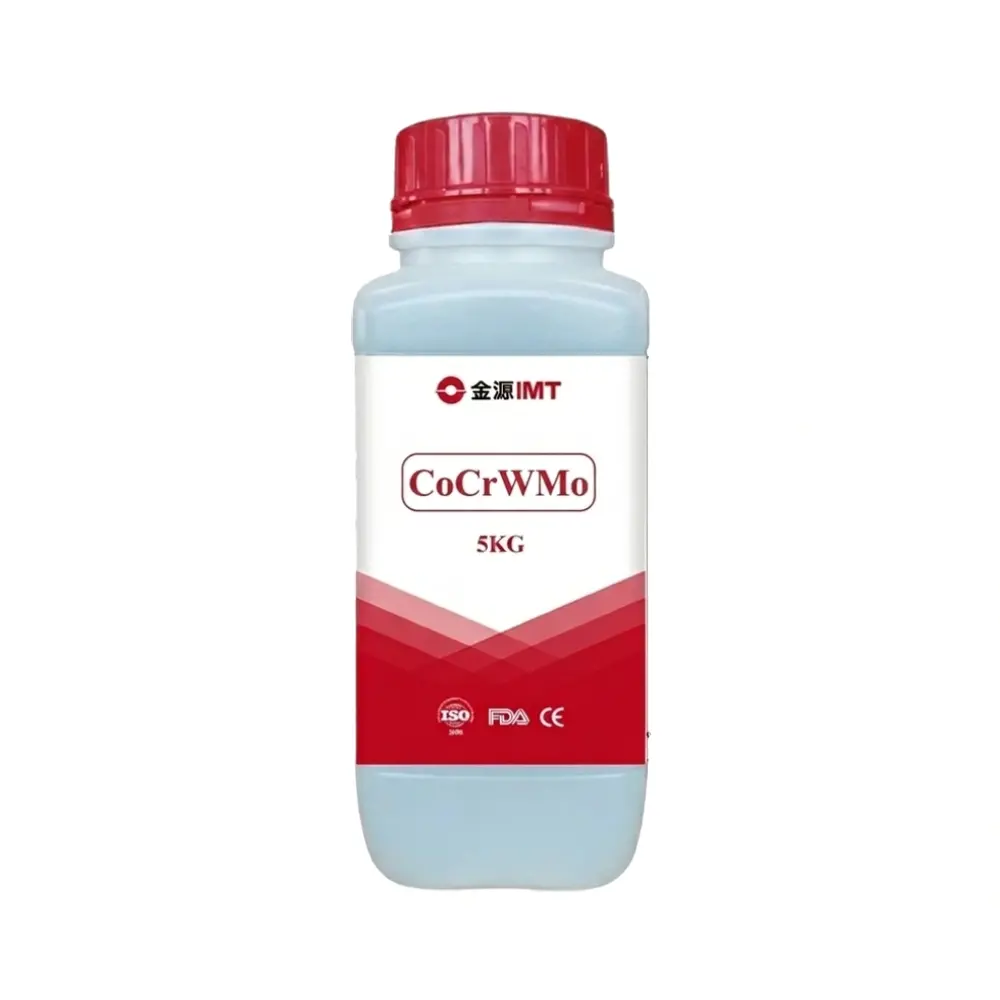
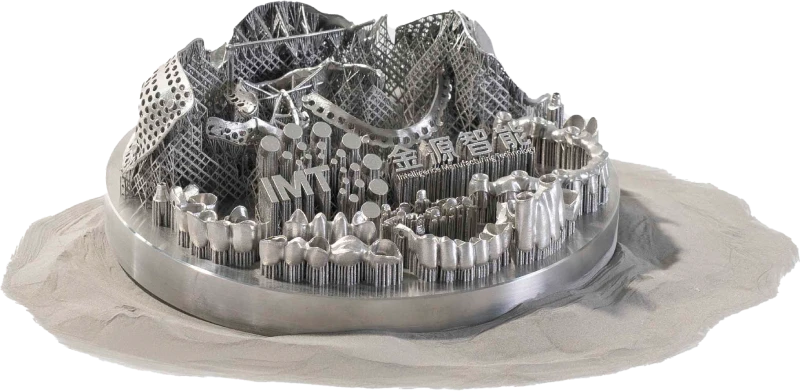
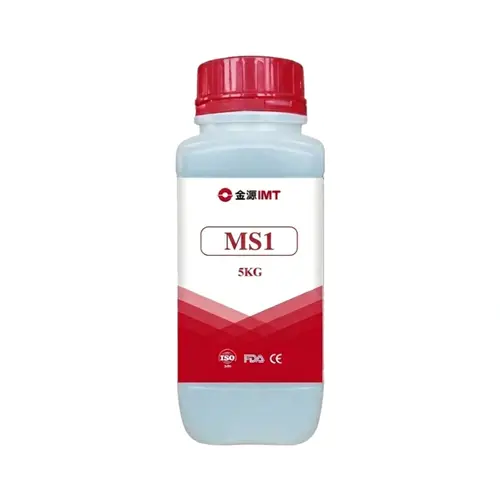
IMT CoCrWMo is a cobalt-based metal powder designed for 3D printing using SLM and LPBF technologies. It is used in the production of medical implants, dental prostheses, and loaded industrial parts. The material has high strength, biocompatibility, and corrosion resistance. The 15–53 μm fraction provides a flowability of 14.0 s/50g, allowing the creation of dense elements with complex geometry. The material is supplied in sealed containers of 5 kg.
Advantages of CoCrWMo powder in 3D printing
Full biocompatibility. Due to the absence of nickel and beryllium in the composition, the metal alloy is absolutely safe for biological tissues, allowing its use for permanent implantation.
Maximum printing accuracy. A sphericity index of granules ≥ 85% guarantees uniform layer formation and stability of the laser sintering (SLM) process.
Oxidation resistance. Finished elements fully retain their physical properties, structure, and original appearance even under the influence of aggressive environments.
Technological properties of CoCrWMo powder
The IMT metal powder is optimized for layer-by-layer laser melting. Thanks to the high sphericity of particles from 85% and above, the powder is evenly distributed on the working platform of the 3D printer. This prevents the formation of voids in the structure of the finished product, guaranteeing stable metal density.
The absence of nickel and beryllium in the composition makes the alloy safe for prolonged contact with living tissues, which is critically important for the medical field. In addition, the finished material demonstrates resistance to oxidation in chemically aggressive environments and stability of geometric dimensions when heated.
IMT CoCrWMo is suitable for SLM printing of cobalt-chrome parts with high strength, wear resistance, and stable quality of formation.
Applications
Dentistry: printing of crowns, bridge and clasp prostheses, individual abutments.
Orthopedics and traumatology: manufacturing of surgical templates, joint and bone endoprostheses.
Aerospace and energy: production of gas turbine elements, blades, and engine parts that operate under thermal load.
Industrial engineering: creating pump assemblies, valves, and wear-resistant parts for the chemical industry.
IMT CoCrWMo is used for SLM printing of strong metal parts from cobalt-chrome alloy with high wear resistance.
Chemical composition of the material
Element
Mass fraction
Purpose
Cobalt (Co)
62.17%
Base of the alloy, providing strength and wear resistance
Chrome (Cr)
25.53%
Forms a protective layer and provides corrosion resistance
Tungsten (W)
5.38%
Increases hardness and stability when heated
Molybdenum (Mo)
5.20%
Enhances resistance to local corrosion and improves mechanics
Silicon (Si)
1.11%
Technological additive to improve properties
Oxygen (O)
0.046%
Controlled residual content of the element
Nitrogen (N)
0.022%
Controlled residual content of the element
Physical and mechanical parameters
Parameter
Value
Hardness
360 HV 10
Yield strength (Rp0.2%)
753.5 MPa
Thermal expansion coefficient
14.3 × 10⁻⁶/K⁻¹
Hall flowability
14.0 s/50g
Particle size
15–53 μm
Particle sphericity
≥ 85%
Delivery form
5 kg
About the manufacturer IMT
The international brand IMT (Intelligent Manufacturing Technology) specializes in the industrial production of spherical metal powders for additive technologies. The company's products are distinguished by the purity of the chemical composition, excellent spherical shape of granules, and uniform distribution of particles by size. Thanks to laboratory testing of each batch of raw materials, the manufacturer guarantees complete predictability of laser melting and high reliability of finished components.
Buy IMT CoCrWMo cobalt-chrome powder in Ukraine
Do you want to get professional technical advice on setting up 3D printing modes or buy IMT CoCrWMo metal powder for your enterprise? Our specialists will help select the optimal parameters of laser melting for the technical characteristics of your equipment. Contact us to find out the current price per bottle or place an order with delivery throughout Ukraine.
Key Parameters
Printing technology
SLM, LPBF
Biocompatibility
Yes
Country of origin
China
Manufacturer
Brand
IMT
Metal Powder Specifications
Particle Size Range
15–53 μm
Particle Shape
Spherical
Size & Weight
Net Weight (kg)
5 kg
Reviews
0/ 5
average product rating
Write a review
0
0
0
0
0
There are no reviews for this product. Be the first to leave your review.
No questions about this product, be the first and ask your question.
We use cookies and other tracking technologies to improve the website, personalize content, and analyze traffic. You can adjust your settings in the settings.
Necessary cookies enable core functionality of the website. Without these cookies the website can not function properly.
Statistic cookies help website owners to understand how visitors interact with websites by collecting and reporting information anonymously.
A set of cookies to collect information and report about website usage statistics without personally identifying individual visitors to Google.
Marketing cookies store user data and behavior information, which allows advertising services to target more audience groups.
We use cookies and other tracking technologies to improve the website, personalize content, and analyze traffic. You can adjust your settings in the settings.
Necessary cookies enable core functionality of the website. Without these cookies the website can not function properly.
Statistic cookies help website owners to understand how visitors interact with websites by collecting and reporting information anonymously.
A set of cookies to collect information and report about website usage statistics without personally identifying individual visitors to Google.
Marketing cookies store user data and behavior information, which allows advertising services to target more audience groups.