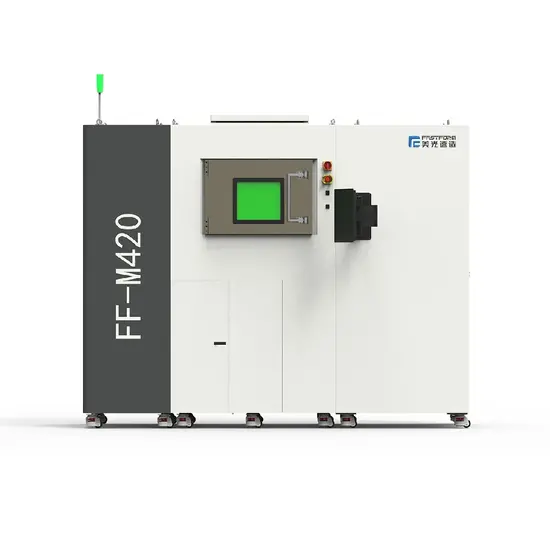
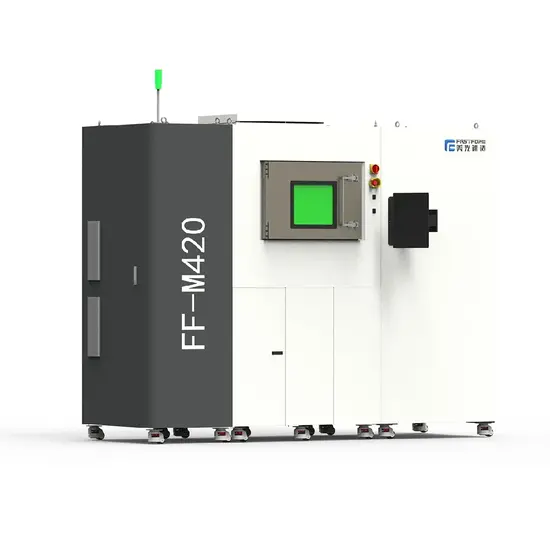
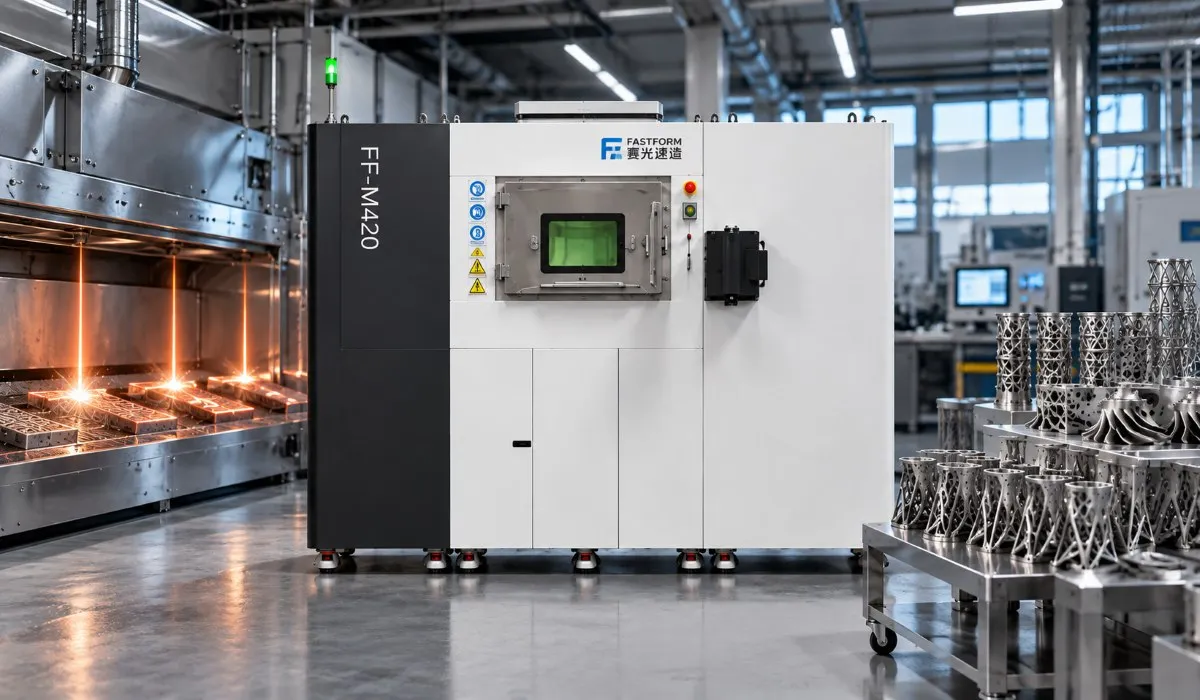
FastForm FF-M420 500W×4 is an industrial 3D printer for manufacturing metal parts using SLM technology. Equipped with four 500 W fibre lasers, it is designed for the serial production of functional components, moulds, complex metal structures, and industrial tooling. The 420 × 380 × 400 mm build volume makes it possible to print large-scale products or multiple parts simultaneously.
Four lasers for high-performance SLM printing. Fibre lasers with an output of 500 W each ensure parallel sintering of metal parts, reducing production time.
Large build volume. The 420 × 380 × 400 mm build envelope is suitable for printing large components and batch manufacturing of parts.
High printing accuracy. The stated accuracy is ±0.1 mm for parts up to 100 mm and ±0.1% for larger items.
Automated powder recoating. A bi-directional system operating at 10–500 mm/s accelerates layer deposition, while powder feed monitoring and recoater blade load sensing reduce the risk of malfunctions.
Coordinated laser operation. Dynamic seamless stitching technology for scanning zones ensures coordinated formation of adjacent part sections.
Durable filtration system. A permanent filter with a service life of over 30,000 hours delivers 99.9% filtration efficiency for particles as small as 0.5 µm.
Automated print monitoring. Monitoring of temperature, oxygen concentration, and process chamber parameters, featuring print resume capability after power interruptions.
FastLayer and FastFab software. Dedicated tools for model preparation, parameter configuration, equipment operation, and production control.
Four-laser system for industrial metal 3D printing
The FastForm FF-M420 500W×4 is equipped with four 500 W fibre lasers that ensure layer-by-layer melting of metal powder. The multi-laser configuration distributes the build process across several channels, boosting productivity when fabricating large parts and during mass production.
Dynamic seamless stitching technology for scanning zones coordinates laser operation, ensuring seamless consolidation across adjoining areas. The wavelength is 1080 ± 10 nm, and the laser beam spot size is adjustable from 50 to 300 µm to adapt to part geometry and powder characteristics.
The maximum scanning speed reaches 10 m/s. A digital scanning system with an optical encoder ensures repeatability and positioning accuracy of ≤2 µrad.
Part accuracy and SLM printing parameters
The FastForm FF-M420 500W×4 delivers a specified accuracy of ±0.1 mm for parts up to 100 mm and ±0.1% for larger components. Actual performance depends on the material, geometry, model orientation, and print parameters.
Powder layer thickness is adjustable between 20 and 150 µm, allowing users to optimise the balance between precision and build rate. The manufacturer provides printing benchmarks for titanium and aluminium alloys at a 60 µm layer thickness, and tool steel and stainless steel at 100 µm.
The build platform features a closed-loop servo drive. The minimum Z-axis movement increment is 1 µm, and the maximum platform preheating temperature reaches 200 °C.
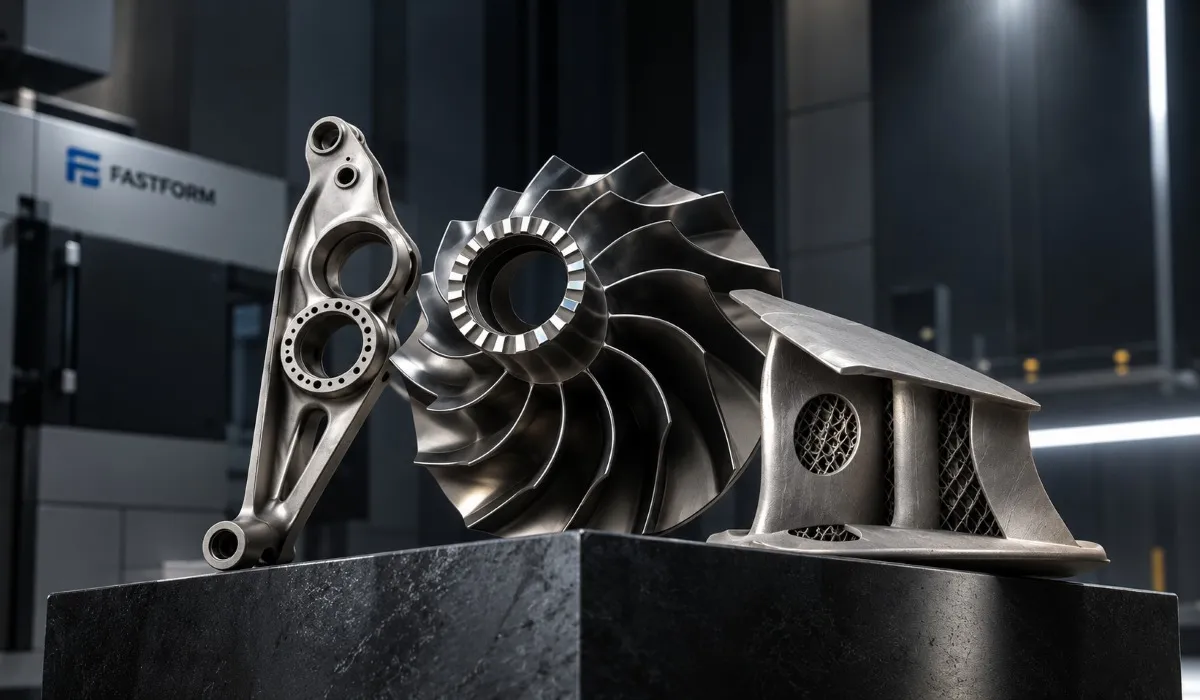
Examples of metal parts with complex geometry.
Automated powder feeding and bi-directional recoating
The FastForm FF-M420 uses a top-feeding metal powder delivery system with automated dosing and bi-directional recoating. Depositing a new layer during recoater blade movement in both directions significantly reduces idle travel times.
Recoating speed is adjustable from 10 to 500 mm/s, with layer thickness ranging from 20 to 150 µm. The system accommodates both flexible and rigid recoater blades.
The system actively monitors powder availability, feed mechanism operation, and recoater blade resistance. In the event of material depletion, mechanical fault, or critical obstruction contact, the machine alerts the operator and pauses the relevant cycle.
The powder hopper volume is at least 40 L. An optional upgrade is available for automated powder feeding and closed-loop circulation.
Inert atmosphere, oxygen control, and filtration
The FastForm FF-M420 500W×4 supports both nitrogen and argon environments to maintain the protective inert atmosphere required during selective laser melting of metal powders. The choice of shielding gas depends on the alloy type and processing specifications.
A gas circulation and multi-stage filtration system purifies the process environment from particulates and soot generated during the build. A permanent filter with a service life of 30,000+ hours delivers 99.9% filtration efficiency for 0.5 µm particles.
Built-in sensors continuously monitor oxygen concentration and chamber pressure. An alert is triggered if parameters drift outside safe operating thresholds. Safety features also include ambient room oxygen sensing, emergency stop functions, and safety interlocks on access doors during laser operation.
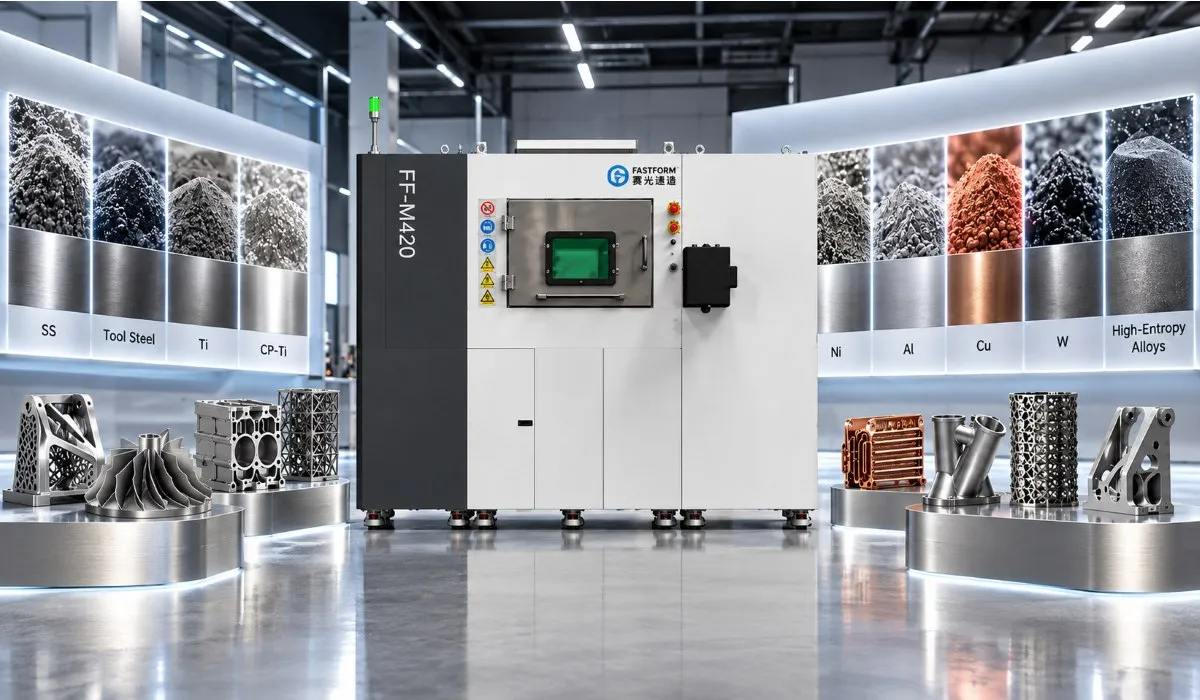
Materials for metal SLM printing.
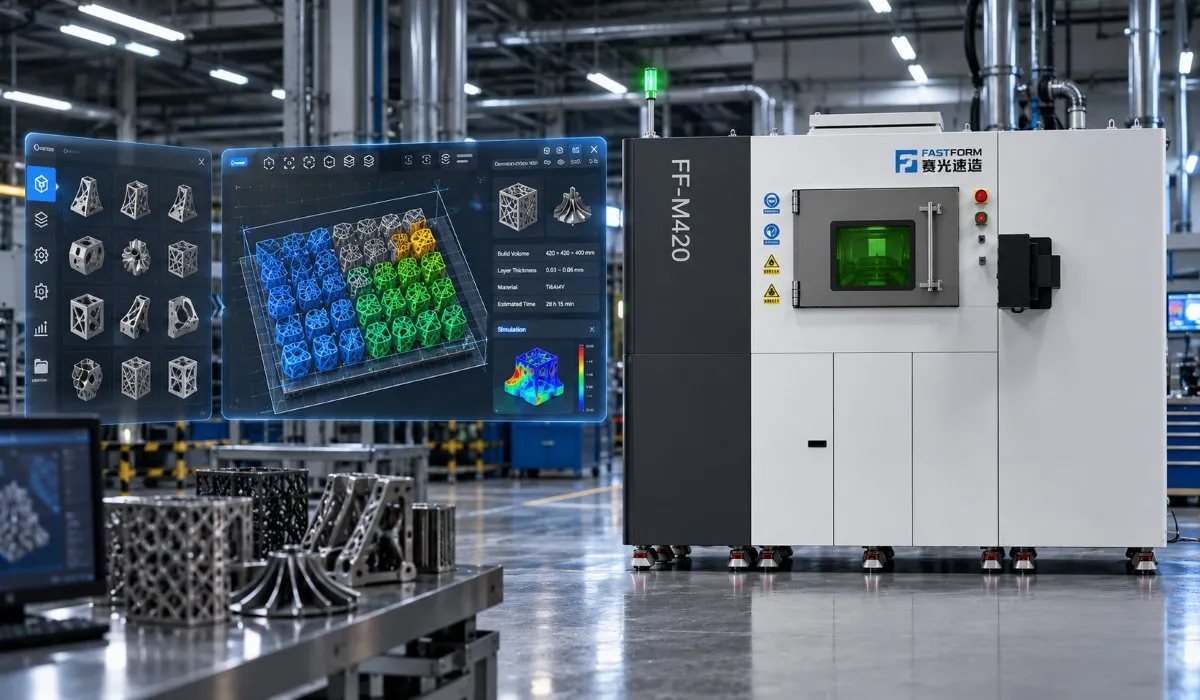
Software for SLM print preparation and system control
FastLayer is dedicated to preparing 3D models for printing. It supports geometry editing, support generation, slicing, laser toolpath configuration, laser power, speed, and layer thickness optimisation.
FastFab provides 3D printer machine control and production process monitoring. The software tracks temperature, oxygen levels, and completed layer count, offering both automatic and manual operating modes.
A power-loss recovery function minimises the risk of losing unfinished parts and improves overall manufacturing reliability.
Model preparation and SLM print management.
Metals and alloys for 3D printing
The FastForm FF-M420 500W×4 industrial 3D printer supports printing with a wide variety of metal powders, facilitating the manufacture of functional prototypes, complex structural parts, injection moulds, and production tooling. Selective laser melting (SLM) technology enables the fabrication of metallic components featuring intricate internal channels, complex geometries, and consolidated functional features.
The following material groups can be utilised for additive manufacturing:
Tool steel. Used for manufacturing moulds, stamping dies, tooling inserts, and tooling subjected to heavy mechanical stresses. Ideal for producing components requiring high strength and wear resistance.
Stainless steel. Employed for printing housings, fasteners, structural elements, and functional assemblies. Combines mechanical durability with corrosion resistance, making it in high demand across mechanical engineering and industrial manufacturing.
Titanium alloys. Characterised by superior specific strength, low density, and high corrosion resistance. Used in aerospace, medical device manufacturing, and high-load complex-geometry components.
Aluminium alloys. Suitable for lightweight enclosures, brackets, structural components, and heat exchangers. Enables significant weight reduction while maintaining required structural performance.
Superalloys / high-temperature alloys. Intended for components operating in high-temperature environments. Widely applied in power generation equipment, aviation systems, and high-performance industrial machinery.
Cobalt-chrome alloys. Used for wear-resistant components, specialised industrial parts, and medical devices. Processing requires appropriate print parameters and dedicated post-processing routines.
Other metallic materials. Given proven compatibility and calibrated process parameters, printing with copper alloys and high-entropy alloys is also possible.
Metal 3D printing quality depends directly on precise process parameter calibration. For each powder, laser power, scan speed, layer thickness, hatch strategy, and shielding gas parameters must be configured. Please consult the specific FastForm FF-M420 500W×4 hardware configuration for the detailed list of validated materials and available print profiles.
FastForm FF-M420: Materials for metal 3D printing on the FastForm FF-M420.
Industrial 3D printer applications
The FastForm FF-M420 500W×4 is engineered for metal additive manufacturing across mechanical engineering, tooling, aerospace, and related industries. Its four-laser system and 420 × 380 × 400 mm build envelope allow the production of large-format components, complex metal assemblies, and full production batches in a single build cycle.
Key application areas:
Footwear industry. Manufacturing metal shoe moulds, lasting inserts, and footwear production tooling. SLM printing enables complex surface textures and conformal internal cooling channels.
Tool and mould making. Creating injection moulds, dies, moulding inserts, and bespoke fixtures. The technology allows conformal cooling channels to be integrated directly into the core design of metal tooling.
Aerospace. Fabricating lightweight structural parts, brackets, housings, and intricate components from titanium, aluminium, and superalloys. Additive manufacturing offers extensive potential for topological optimisation and weight reduction.
Mechanical engineering. Production of functional prototypes, fixtures, custom housings, production tooling, and industrial machinery components. Metal 3D printing is particularly advantageous for complex structures and low-volume production runs.
Electronics and instrumentation. Printing compact enclosures, mounting hardware, thermal management heat sinks, and parts with intricate internal geometry.
Medical sector. Manufacturing customised metal implants, surgical instruments, medical device prototypes, and specialist assemblies from certified biocompatible alloys. Production must comply with applicable regulatory standards.
Education and research. Investigating SLM processes, researching metal powder properties, developing novel laser melting strategies, and producing experimental specimens.
The FastForm FF-M420 500W×4 is an ideal solution for enterprises seeking to expand metalworking capabilities, manufacture complex components without conventional tooling, and integrate additive technologies into their production workflows.
Laser system and SLM print parameters
Parameter
Value
3D printing technology
SLM (selective laser melting)
Laser type
Ytterbium fibre laser
Build volume
420 × 380 × 400 mm
Number of lasers
4
Individual laser power
500 W
Laser wavelength
1080 ± 10 nm
Laser power adjustment
10–100%
Laser beam diameter
50–300 µm
Maximum scanning speed
10 m/s
Powder layer thickness
20–150 µm
Forming accuracy
±0.1 mm
Scanning repeatability and positioning accuracy
≤2 µrad
Minimum travel step
1 µm
Platform preheating temperature
200 °C
Scanning system
High-precision digital scanning system with optical encoder
Laser cooling
Water-cooled
Net dimensions
2780 × 1140 × 2200 mm
Net weight
1600 kg
Powder delivery system and filtration
Parameter
Value
Powder feed method
Top feeding
Powder recoating
Bi-directional
Recoater blade type
Flexible / rigid
Recoating speed
10–500 mm/s
Powder hopper volume
≥40 L
Recoater blade length
≥390 mm
Shielding gas
Nitrogen or argon
Filtration system
Permanent filter
Filter service life
≥30,000 hours
Particulate filtration efficiency
99.9%
Equipment specifications and software
Parameter
Value
Average power consumption
≤6 kW
Power supply
380 V, three-phase
Operating ambient temperature
18–28 °C
Relative humidity
≤70%
Gas flow rate during purging
15 L/min
Gas flow rate during operation
5 L/min
Oxygen monitoring system
Yes
Build chamber parameter monitoring
Yes
Power-loss print recovery
Supported
Control modes
Automatic / manual
Software
FastLayer, FastFab
Order the FastForm FF-M420 500W×4 industrial 3D printer
Order the FastForm FF-M420 500W×4 today! Contact us for professional consultation regarding technical specifications, compatible metal powders, configuration options, delivery terms, installation, and machine commissioning.
Key Parameters
Printing technology
SLM
Build volume (X×Y×Z) (mm)
420*380*300
Printing accuracy (µm)
50
Oxygen content (ppm)
≤ 0,1%
Minimum layer height (µm)
20 - 150
Country of origin
China
3D Printing
Supported Materials
CoCr, titanium alloy, pure titanium, aluminum alloy, nickel alloy, stainless steel, etc.
Additional Information
Certificates
CE
Warranty Period (months)
12
Details
Gas supply
Ar / N₂
Electrical
Power Requirements
Three-phase 380V, maximum 15 kW
Hardware & Performance
Laser Characteristics
500 W, 4 lasers Fibre laser
Laser Engraving and Cutting
Laser Spot Size (mm)
0.02 - 0.05
Safety
Air Handling
Permanent filter, service life at least 30,000 hours
Size & Weight
Net Weight (kg)
1600
Software & Connectivity
Supported File Formates
STEP, IGES, SLC, CLI, STL
Connectivity
Wi-Fi
Software
Fastlayer, FastFab
Supported Operating System
Windows 10
Special Function
Features
Resume printing after power failure, Auto power off, Top powder feeder
Speed
Max Scan Speed (mm/s)
10 000
Reviews
0/ 5
average product rating
Write a review
0
0
0
0
0
There are no reviews for this product. Be the first to leave your review.
No questions about this product, be the first and ask your question.
Ask a Question
FAQ
What are metal 3D printers used for?
Metal printing systems are acquired for the rapid production of components with highly complex geometries that are either impossible or economically unfeasible to create using traditional milling or casting.
The most effective applications for this equipment include:
Rapid manufacturing of unique molds, fixtures, jigs, and other specialized factory tooling;
Creating weight-optimized, lightweight parts with internal lattice structures for engines or aerospace applications;
On-demand repair of complex machinery by quickly producing rare or obsolete spare parts;
Launching small-batch production of functional parts without the high costs of creating traditional metal casting molds.
What is the difference between SLM printing and metal extrusion?
The primary difference is that SLM technology melts a monolithic part in a single stage directly within the build chamber using a laser, whereas Metal FFF extrusion requires additional stages of chemical debinding and sintering in a furnace.
Both additive manufacturing methods offer unique advantages for specific tasks:
Laser Powder Bed Fusion (SLM/DMLS): High-power lasers melt fine metal powder. This ensures exceptional part density (up to 99.9%) and high geometric precision, making it ideal for the aerospace and defense industries. This segment includes industrial systems from Eplus3D, FastForm, Omni3D, and Sharebot.
Metal Filament Extrusion (Metal FFF): The printer deposits a filament filled with metal powder to form a "green" part. After printing, the binder polymer is chemically removed (debinding), and the part is sintered in a high-temperature furnace. This method is significantly safer, more affordable, and suitable for standard workshop environments (e.g., the Raise3D ecosystem).
How does Metal FFF technology work?
Metal FFF technology consists of three consecutive stages: printing the workpiece with metal-filled filament, chemical debinding of the binder polymer, and final sintering in a high-temperature furnace.
Step-by-step process of part creation:
Printing: The printer builds the model layer-by-layer using a specialized metal rod/filament, where metal dust is mixed with polymer and wax.
Debinding: The "green" part is washed in a chemical solution to remove the primary binding polymer.
Sintering: In a high-temperature furnace under a protective gas environment, the remaining polymer burns off, and the metal microparticles fuse together into a solid, high-strength metal part. The slicer software automatically scales the model before printing to compensate for shrinkage during sintering.
What are the advantages of 3D printing with metal powders?
The main advantage of powder printing via SLM technology is the near-total absence of raw material waste and the maximum strength of the resulting monolithic products.
Key environmental and production benefits include:
Reusability: All unused metal powder remaining in the chamber after a cycle is sieved through a vibrating screen and reused in the next build, minimizing waste;
Maximum Density: Laser melting achieves a monolithic metal structure without porosity, guaranteeing strength that often exceeds traditional casting.
What metals can be used for 3D printing?
Modern 3D printing systems support a wide range of industrial alloys, including stainless and tool steels, titanium, aluminum, copper, and Inconel.
The choice of alloy depends on your specific manufacturing requirements:
Stainless Steels (316L, 17-4 PH): Ideal for machine parts, fasteners, molds, and food-grade equipment;
Titanium and Cobalt-Chrome: Widely used in high-precision medical prosthetics, aerospace, and defense industries;
Aluminum and Copper: Perfect for lightweight structures, heat exchangers, and electrical engineering components.
How do service support and commissioning work?
Our company provides a full range of "turnkey" services — from designing the workspace and installing systems to certified staff training and ongoing technical service.
With over 10 years of hands-on experience, we take full technical responsibility:
We perform commissioning and setup of any complexity directly at your production facility;
We provide professional training for your operators on software usage, print parameter optimization, and safe raw material handling.
We use cookies and other tracking technologies to improve the website, personalize content, and analyze traffic. You can adjust your settings in the settings.
Necessary cookies enable core functionality of the website. Without these cookies the website can not function properly.
Statistic cookies help website owners to understand how visitors interact with websites by collecting and reporting information anonymously.
A set of cookies to collect information and report about website usage statistics without personally identifying individual visitors to Google.
Marketing cookies store user data and behavior information, which allows advertising services to target more audience groups.