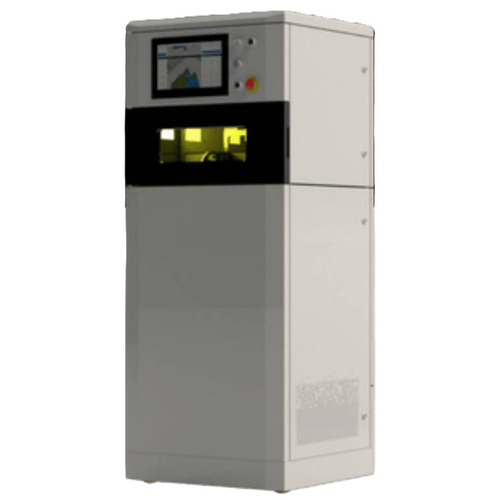
FastForm AiForm-G1 — industrial SLM 3D printer for metal printing, created for tasks where precision, geometry stability, and surface quality are critical. The model is focused on manufacturing complex parts with thin walls and repeatable results in the production cycle.
Density and accuracy of parts from batch to batch
AiForm-G1 operates using Selective Laser Melting (SLM) technology — layer-by-layer melting of metal powder with a laser, which allows obtaining parts with high density and reliable mechanical properties. This approach is especially valuable when it is necessary to combine complex geometry, precision, and result stability from batch to batch.
500W green laser for reflective metals
Most industrial SLM printers use infrared (IR) lasers, but FastForm AiForm-G1 is equipped with a 500W green single-mode fiber laser. This is fundamentally important when you plan to print with pure copper or precious metals, which strongly reflect infrared radiation, as well as when maximum accuracy in manufacturing aluminum components with internal channels for liquid cooling is required. What happens during the printing process:
Better energy absorption. Copper and gold absorb the green spectrum much more efficiently than infrared. This makes the melting process more stable — without "spitting" and the risk of overheating the optics.
Higher density and fewer pores. Energy is predictably transferred to the metal powder, so it is easier to obtain parts with high density and a minimum of micropores — critical for conductivity and heat transfer (electronics, heat exchangers).
Ultra-thin walls and fine structures. The shorter wavelength allows focusing the beam into an extremely small point. This makes thin-walled elements from 0.1 mm, grids, and thin radiators realistic.
Process stability. Copper is characterized by an "unstable melt bath" with an IR laser due to strong reflection. The green laser provides more uniform melting from the start of the layer, which directly enhances the stable repeatability of the result.
Highly reflective parts printed in the SLM system FastForm AiForm-G1
Key advantages of AiForm-G1
Optimal build area 140×140×200 mm: convenient format for small and medium parts, grids, cooling channels, thin-walled elements.
Green single-mode fiber laser 500 W: energy for stable melting and productive work.
Intelligent focusing: for stable quality across the entire build plane.
High scanning speed up to 7 m/s: faster layer formation and better production cycle efficiency.
Printing thin walls from 0.1 mm: important for heat exchangers, lattice structures, and lightweight constructions.
Layer thickness 20–60 μm: balance between detail and print speed.
Permanent filter: a constant filter to minimize downtime and replacements.
Proprietary software: the printer comes with the FastLayer/FastFab ecosystem, which simplifies preparation and management of the printing process within a single software stack.
Where AiForm-G1 gives maximum benefits
An SLM platform of this class usually performs best in tasks:
prototyping and small batch production of metal parts;
parts with internal channels, porous/lattice structures;
components with accuracy and repeatability requirements;
high-efficiency heat exchangers made of pure copper;
parts or products made of precious metals, where quality without defects is important.
Technical specifications of FastForm AiForm-G1
Parameter
Value
Printing technology
SLM (Selective Laser Melting)
Print area (L×W×H)
140×140×200 mm
Layer thickness
20–60 μm
Print accuracy
Min. wall thickness 0.1 mm
Computational power
TFLOPS
Scanning speed
up to 7 m/s
Laser
Single-mode Green Fiber Laser, 500 W
Focusing system
Scene Intelligent Focusing
Laser spot size
15–40 μm
Printer dimensions (L×W×H)
1750×800×1800 mm
Need a consultation on configuration and solution selection for your parts?
For all questions regarding SLM printing and selection of the optimal configuration, please contact the specialists of 3DPrinter — we will help you choose a solution for your tasks, materials, and quality requirements.
We use cookies and other tracking technologies to improve the website, personalize content, and analyze traffic. You can adjust your settings in the settings.
Necessary cookies enable core functionality of the website. Without these cookies the website can not function properly.
Statistic cookies help website owners to understand how visitors interact with websites by collecting and reporting information anonymously.
A set of cookies to collect information and report about website usage statistics without personally identifying individual visitors to Google.
Marketing cookies store user data and behavior information, which allows advertising services to target more audience groups.
We use cookies and other tracking technologies to improve the website, personalize content, and analyze traffic. You can adjust your settings in the settings.
Necessary cookies enable core functionality of the website. Without these cookies the website can not function properly.
Statistic cookies help website owners to understand how visitors interact with websites by collecting and reporting information anonymously.
A set of cookies to collect information and report about website usage statistics without personally identifying individual visitors to Google.
Marketing cookies store user data and behavior information, which allows advertising services to target more audience groups.